Drop 006
Named for the Blue Ridge Mountains. The railroad made her — and the train still runs.
“Named for the Blue Ridge Mountains. The railroad made her — and the train still runs.”
Blue Ridge wasn’t a town until the train needed one. This was Cherokee ground before the town, and Fannin County was cut out of Gilmer and Union in 1854 — named for James Fannin, who died with his men at Goliad in Texas. The county seat was Morganton, up the road. Then the Marietta and North Georgia Railroad came through in the summer of 1886, and it skipped Morganton entirely — the flat ground along the Toccoa River was easier than the hills. Colonel Mike McKinney, who pushed to bring the railroad through, laid out a new town right where the tracks ran. The town took the name of the mountains around it, and it was incorporated on October 24, 1887. Nine years later the county seat followed the train. The dam went in down the river in 1930 and made Lake Blue Ridge. The Merciers started growing apples in 1943, and their orchard is still going, four generations on. And in 1998 the train came back as the Scenic Railway, running the same 26 miles down the Toccoa to McCaysville and back.
The depot — the town grew around it, and the Scenic Railway still runs 26 miles down the Toccoa River to McCaysville.
34.87° N, 84.32° W
Tap the card for fast facts
Blue Ridge wasn’t a town until the train needed one. This was Cherokee ground before the town, and Fannin County was cut out of Gilmer and Union in 1854 — named for James Fannin, who died with his men at Goliad in Texas. The county seat was Morganton, up the road. Then the Marietta and North Georgia Railroad came through in the summer of 1886, and it skipped Morganton entirely — the flat ground along the Toccoa River was easier than the hills. Colonel Mike McKinney, who pushed to bring the railroad through, laid out a new town right where the tracks ran, and his store and sawmill were its first businesses. The town took the name of the mountains around it — the blue haze that hangs over them — and it was incorporated on October 24, 1887.
Nine years later the county seat followed the train. The judges and lawyers couldn’t easily get from the Blue Ridge station to Morganton’s courthouse, so in 1895 the voters moved the seat to Blue Ridge, and it’s been there ever since.
For a while Blue Ridge was a health resort — people rode the train up from the city for the pure mineral waters, ate dinner at the Blue Ridge Hotel, and walked to the springs after. The first depot burned; the one standing now went up in 1906. The noon train from Knoxville used to stop twenty minutes for lunch. The dam went in down the river in 1930 and made Lake Blue Ridge. The Merciers started growing apples in 1943, and their orchard is still going, four generations on. And in 1998 the train came back as the Scenic Railway, running the same 26 miles down the Toccoa to McCaysville and back.
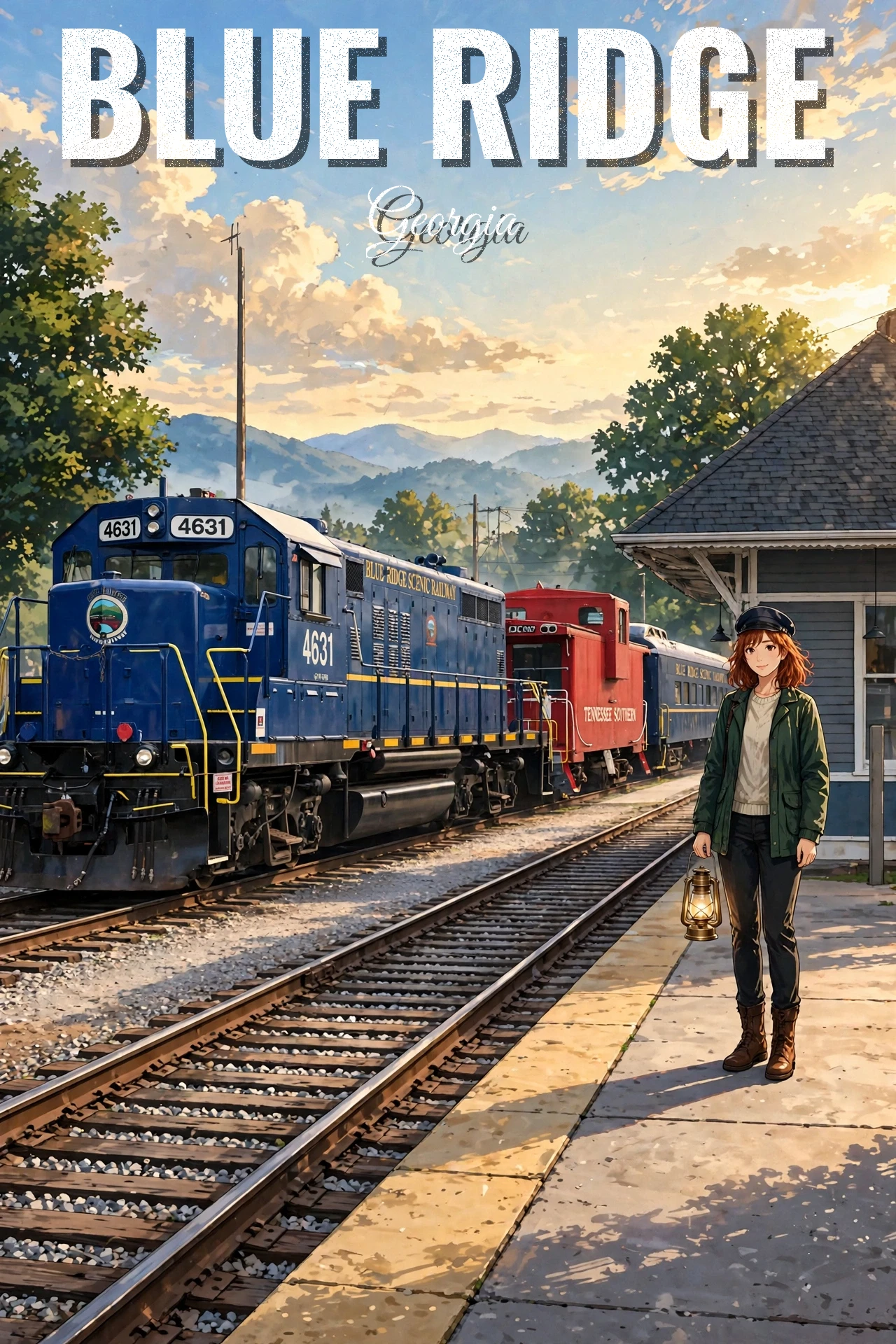
She’s the depot at her back and the train that never really left — cap on, lantern lit, waiting on the platform like she’s done since 1886.
The railroad is the town’s whole story — it was laid out because the tracks came through, and the depot is still the center of downtown.
She’s the railway, not a passenger — the town runs the train now.
The depot behind her is the real one, built in 1906, and the blue engine is the Scenic Railway’s 4631 — the line’s main locomotive, deep blue with yellow trim.
The mountains behind her are the Blue Ridge themselves — the blue haze is isoprene from the trees, and it’s where the town got its name.
Mercier Orchards has grown apples here since 1943 — 300 acres, four generations.
Blue Ridge, Fannin County, Georgia
A railroad town at the southern gateway of the Blue Ridge — laid out because the tracks came through, county seat because the train was easier to reach, and the train still runs. This is the history the Blue Ridge card is built from.
This was Cherokee ground before the town — the Cherokee towns nearby were Fightingtown, now Epworth, and Hot House, past Mineral Bluff. Fannin County was formed on January 21, 1854, out of Gilmer and Union counties, named for Colonel James W. Fannin, who was captured and massacred with his men at Goliad, Texas, in 1836. The first county seat was Morganton, up the road, where a courthouse went up in 1855.
The Marietta and North Georgia Railroad came through in the summer of 1886, and it bypassed Morganton — the flat ground along the Toccoa River was easier than the hills. Colonel Mike McKinney, the Civil War veteran who pushed to bring the railroad through, laid out a new town right where the tracks ran. His general store, sawmill and real-estate business were its first businesses, and his house was the first one built. The land had belonged to farmer John Green; his son Elisha donated land and helped survey and plat the town. The railroad’s engineer, C. R. Walton, had surveyed and laid out the town, and he and McKinney had a hand in where the tracks ran. The railroad itself was run in its first years by General William Phillips, the former Confederate commander of Phillips’ Legion, as president; in 1887 Boston publisher R. M. Pulsifer took over as president.
Blue Ridge was incorporated on October 24, 1887, by an act of the Georgia Legislature. She took the name of the mountains around her — the southern gateway of the Blue Ridge, blue from the misty haze.
On December 13, 1895, a referendum — two-thirds in favor — moved the county seat from Morganton to Blue Ridge. The judges and lawyers couldn’t easily get from the Blue Ridge train station to Morganton’s courthouse, so the seat followed the train. It’s been in Blue Ridge ever since.
The first depot burned, and the present station went up in 1906. The noon train from Knoxville used to stop twenty minutes for lunch, and the morning train took four hours to Atlanta. The railroad is still the central focus of downtown.
Blue Ridge Dam was completed down the river, making Lake Blue Ridge — an 11-mile TVA reservoir on the Toccoa, sitting in the Chattahoochee National Forest.
Bill and Adele Mercier bought a 27-acre orchard and the 1925 apple house in 1943. The orchard is now 300 acres, four generations on, growing fifty apple varieties.
Her population peaked at 1,718 in the 1950 census — the most people she’s ever had.
The Blue Ridge Scenic Railway was founded, running the same 26 miles down the Toccoa River to McCaysville, Georgia, and Copperhill, Tennessee, and back — the train that made the town, still running.
She’s down to 1,253 people in the 2020 census, the county seat of Fannin County, and the depot is still the center of downtown. The county calls itself the Switzerland of the South.
Comments
What do you think of Blue Ridge? Say it here — comments show up once Dave gives them a look.
Loading comments…