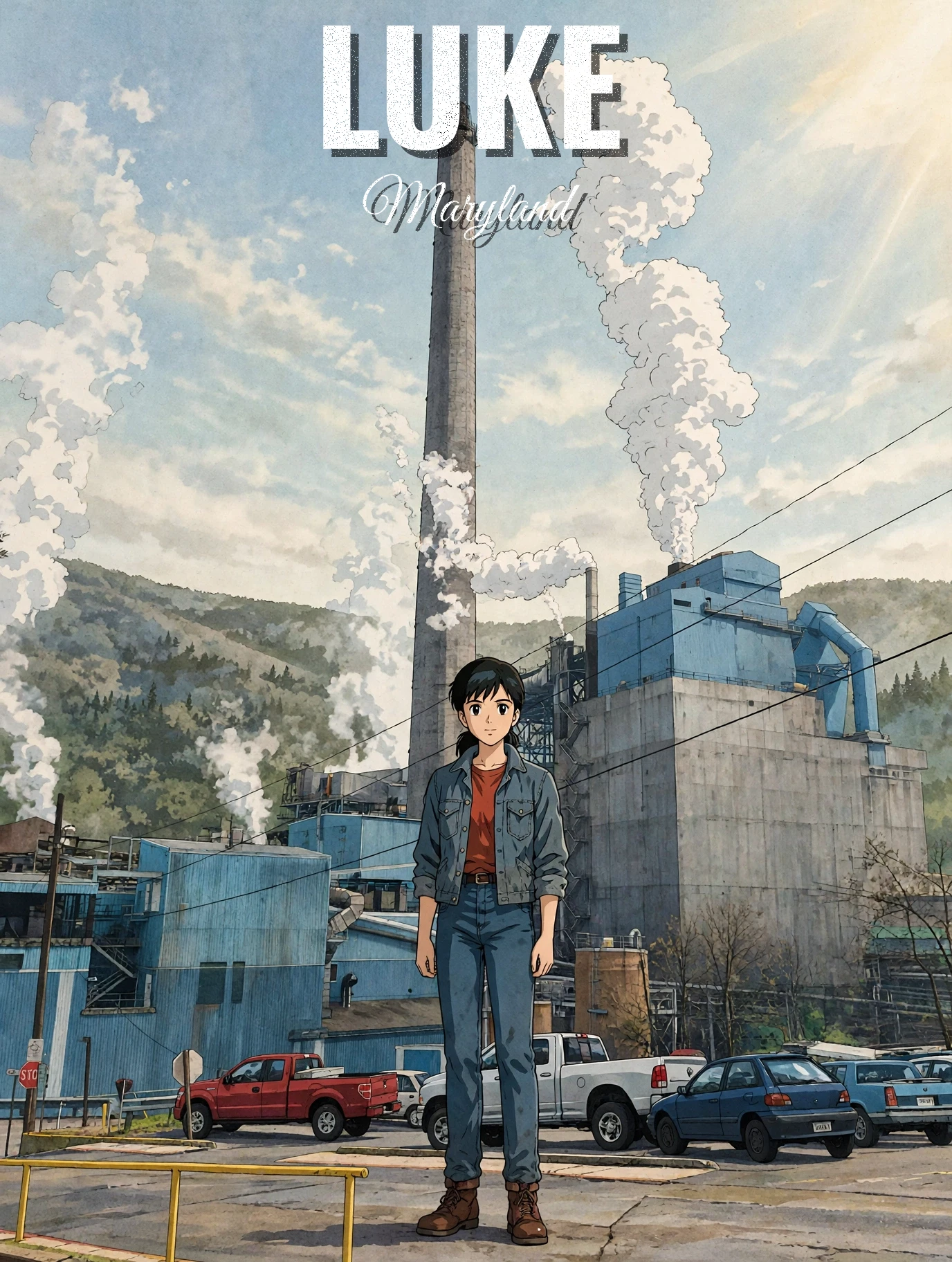
Drop 005
Named for a railroad stop, which took William Luke’s name. She made paper for 131 years — and outlived the mill.
“Named for a railroad stop, which took William Luke’s name. She made paper for 131 years — and outlived the mill.”
Settled in the early 1770s as West Piedmont — land that was once an island in the Potomac, claimed by Piedmont, West Virginia until the river changed course and gave it back to Maryland. The Davis brothers built a sawmill there, cutting cross-ties for the B&O Railroad. When the railroad stopped building in the 1880s, they sold out to William Luke, who built the Piedmont Pulp and Paper Company with his sons in 1888; the railroad named its stop after him. The mill was everything — the largest private employer in Allegany County. It changed hands over the years but the stacks kept smoking, until Verso announced the closure in April 2019. Production ended May 31, after 131 years. Luke peaked at 1,064 people in 1930; 85 in 2020. She’s a paper town, and the paper is gone.
On a bend of the North Branch Potomac at the foot of Backbone Mountain. The paper mill ran for 131 years and was the largest private employer in Allegany County — it closed May 31, 2019, and the 55-acre site is being cleared.
39.48° N, 79.06° W
Tap the card for fast facts
Luke was settled in the early 1770s on a bend of the North Branch Potomac, first as West Piedmont — land that was once an island in the river, claimed by Piedmont, West Virginia until the river changed course and gave it back to Maryland. The Davis brothers built a sawmill there, cutting cross-ties for the B&O Railroad as it pushed west. When the railroad stopped building in the 1880s, the brothers sold out to William Luke, who built the Piedmont Pulp and Paper Company with his sons in 1888. When the railroad needed a name for its stop, it used his: Luke. The town was incorporated in 1922.
The mill was everything — the largest private employer in Allegany County, over $200 million a year into the local economy at its height, supporting the coal and rail and trucking trades around it. It changed hands over the years — Westvaco in 1969, MeadWestvaco in 2002, NewPage in 2005, Verso in 2015 — but the stacks kept smoking. In April 2019 Verso announced the closure. Production ended May 31, 2019, after 131 years, and the mill that had supplied the town’s drinking water went quiet. The 55-acre site started coming down in the summer of 2023. Luke peaked at 1,064 people in 1930; 85 in 2020. She’s a paper town, and the paper is gone. What’s left is the river bend, the mountain, and 85 people who stayed.
131 years, the largest private employer in Allegany County, $200 million a year into the local economy at its height. It supplied the town’s drinking water and paid for most of its wastewater upgrades; when it closed, the town had to rework both.
The railroad needed a name for its stop and used “Luke” after William Luke, founder of the Piedmont Pulp and Paper Company. The town took the stop’s name — the same pattern as Harlan, which took the county’s name rather than the man’s.
Luke, Allegany County, Maryland
A paper town on a bend of the Potomac — settled when the river ran a different course, named for a railroad stop, and she outlived the mill that made her. This is the history the Luke card is built from.
Luke was settled on a bend of the North Branch Potomac, first as West Piedmont — land that was once an island in the river, claimed by Piedmont, West Virginia until the river changed course and gave it back to Maryland. The Davis brothers built a sawmill there, cutting cross-ties for the B&O Railroad as it pushed west.
When the railroad stopped building in the 1880s, the Davis brothers sold out to William Luke, who founded the Piedmont Pulp and Paper Company there with his sons. When the railroad needed a name for its stop, it used his: Luke.
The Luke mills joined with other paper mills William Luke had built in West Virginia and Maryland to form the West Virginia Pulp and Paper Company.
A new two-room school opened in September 1913. It served the town for forty-six years, sending its students on to Bruce High School in Westernport. When the school closed in 1959, the building became the town’s administrative offices.
Luke was incorporated, with a mayor and four commissioners elected every two years.
Her population peaked at 1,064 in the 1930 census, the most people she’s ever had.
The mill became Westvaco in 1969, then MeadWestvaco in 2002, then NewPage in 2005, then Verso in 2015. Through all of it, the stacks kept smoking.
Verso announced the closure on April 30, 2019. Production ended May 31, after 131 years. The Tri-Towns community — Piedmont in West Virginia, with Luke and Westernport in Maryland — was projected to be devastated, and the mill had supplied Luke’s drinking water and paid for most of its wastewater upgrades.
Clearing of the 55-acre former mill site began in August 2023. No concrete plans have been made for what the ground becomes next.
She’s down to 85 people in the 2020 census. The town sits on the Potomac bend at the foot of Backbone Mountain, on MD 135 between Westernport and Oakland.
Comments
What do you think of Luke? Say it here — comments show up once Dave gives them a look.
Loading comments…